
Table of Contents
This length conversion guide shows how to avoid unit mistakes. Most length mistakes are not maths mistakes. They are unit mistakes: someone reads a number correctly and applies it in the wrong system, or mixes feet with inches, or rounds too early and carries the error through a whole cut list. This guide gives you the exact factors, a method you can check by hand, and the places where rounding is safe and where it is not.
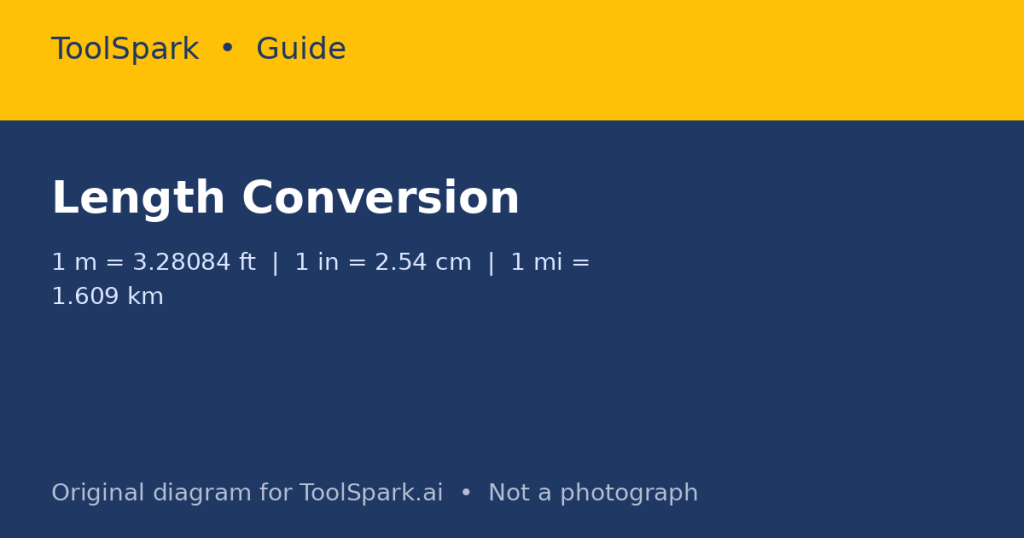
In short: Convert length by multiplying by the exact factor, keeping full precision until the final answer. Use 1 metre = 3.28084 feet, 1 inch = 2.54 centimetres, 1 mile = 1.60934 kilometres, and 1 yard = 0.9144 metres. Before adding or subtracting, convert every value to one base unit, then check the result by converting back.
The exact factors you can trust
The modern system is anchored to the metre. The inch is defined, not measured, as exactly 25.4 millimetres. From that one definition, the rest of the imperial length system follows exactly:
| Unit | Exact definition | Useful conversion |
|---|---|---|
| 1 inch | 25.4 mm exactly | 1 in = 2.54 cm |
| 1 foot | 12 inches | 1 ft = 0.3048 m exactly |
| 1 yard | 3 feet | 1 yd = 0.9144 m exactly |
| 1 statute mile | 5,280 feet | 1 mi = 1,609.344 m exactly |
| 1 nautical mile | 1,852 m exactly | 1 nmi = 1.852 km |
That matters because it tells you which numbers are exact and which are rounded. ‘1 inch = 2.54 cm’ is exact. ‘1 metre = 3.28 feet’ is a rounded shortcut. Use the exact factor for cutting, machining, surveying and any work where a millimetre matters, and use the shortcut only for a quick estimate.
The four conversions people actually search for
Metres to feet, and back
Multiply metres by 3.28084 to get feet. Divide feet by 3.28084, or multiply by 0.3048, to get metres. Worked example: a room wall is 4.75 m long. 4.75 x 3.28084 = 15.584 feet. The 0.584 part is not 58 inches: 0.584 x 12 = 7.0 inches, so the wall is 15 feet 7 inches. That two-step split – whole feet, then decimal feet to inches – is the step most people skip, and it is where most errors come from.
Inches to centimetres, and back
Multiply inches by 2.54 to get centimetres. Divide centimetres by 2.54 to get inches. Example: a 55-inch television is measured diagonally, so 55 x 2.54 = 139.7 cm. The screen is not 55 cm wide; the diagonal is the measurement, which is why a ‘55-inch’ TV is much wider than 55 of any unit in one direction.
Miles to kilometres, and back
Multiply miles by 1.60934 to get kilometres. Multiply kilometres by 0.62137 to get miles. Example: 120 miles x 1.60934 = 193.12 km. For a mental check while driving, multiply kilometres by 0.6: 100 km is about 60 miles, while the exact figure is 62.14 miles. The 0.6 rule underestimates slightly, which is useful to know – it will never make you think a distance is longer than it is.
Yards, centimetres and millimetres
A yard is 3 feet, so a 10-yard fabric length is 30 feet or 9.144 metres. For small work, keep millimetres: 1 cm = 10 mm, and engineering drawings in millimetres avoid the decimal-inch confusion entirely. If a drawing says 2,540 mm, that is exactly 100 inches – a useful check when a drawing looks wrong.
A method that survives checking
- Write down the unit you have and the unit you want, before you touch a calculator.
- Use the exact factor from the table above, not a factor you half-remember.
- Do the multiplication, then sanity-check the direction: converting metres to feet must give a bigger number, because a foot is shorter than a metre. Converting miles to kilometres must also give a bigger number. If your answer moves the wrong way, you divided when you should have multiplied.
- Round only at the end. Rounding 3.28084 to 3.28 at the start of a chain of conversions is how a 2 mm error becomes a 2 cm error.
Common mistakes, and what to do instead
- Mistake: treating a decimal foot as feet and inches. Fix: multiply the decimal part by 12.
- Mistake: using US survey feet for ordinary work. For everyday conversion, the international foot (0.3048 m exactly) is the right one; survey feet are a specialist legacy unit and are not needed for household, travel or classroom work.
- Mistake: converting a squared or cubed length with a linear factor. Area and volume need the factor squared or cubed: 1 square metre is 10.764 square feet, not 3.281. If you are converting floor area or concrete volume, use the area or volume tool, not the length factor.
- Mistake: trusting a single rounded factor for a whole project. Use the tool for the final figure and keep the exact factor in your notes so someone else can reproduce your result.
When to use the converter instead of mental maths
Mental maths is fine for travel estimates and shopping. Use the ToolSpark Length Converter for blueprints, cutting lists, shipping dimensions, exam work you need to show, and any figure another person will act on. The advantage is not just speed: the tool keeps full precision until the result, so you do not accumulate rounding error, and you can swap the direction with one click to check your answer backwards. Length conversions and weight conversions work the same way, with a different exact factor.
Frequently Asked Questions
How many feet are in a metre?
Approximately 3.28084 feet. The exact relationship is 1 foot = 0.3048 metres, so 1 metre = 1 / 0.3048 = 3.2808399 feet, usually rounded to 3.28084.
How many centimetres are in an inch?
Exactly 2.54 centimetres. This has been the international definition since 1959, so it is not an approximation.
What is the difference between a statute mile and a nautical mile?
A statute mile is 5,280 feet (1,609.344 metres). A nautical mile is exactly 1,852 metres and is used in aviation and shipping.
Why do blueprint conversions go wrong?
Usually because feet and inches are mixed up, or a decimal foot (for example 15.58 ft) is read as 15 ft 58 in. Convert the decimal part separately: 0.58 ft x 12 = 7 inches, so 15.58 ft is about 15 ft 7 in.


Community Reviews & Discussion
[…] Length Conversion Guide: Metres, Feet, Inches, Yards, Miles and Kilometres, Explained […]