
Compound interest is often described as the eighth wonder of the world, which is a nice quote and a poor explanation. The useful idea is simpler: when interest is added to your balance, future interest is calculated on a larger balance. That feedback loop is why time matters so much, why small regular contributions add up, and why a loan and an investment with the same rate behave so differently depending on which side of the interest you are on.
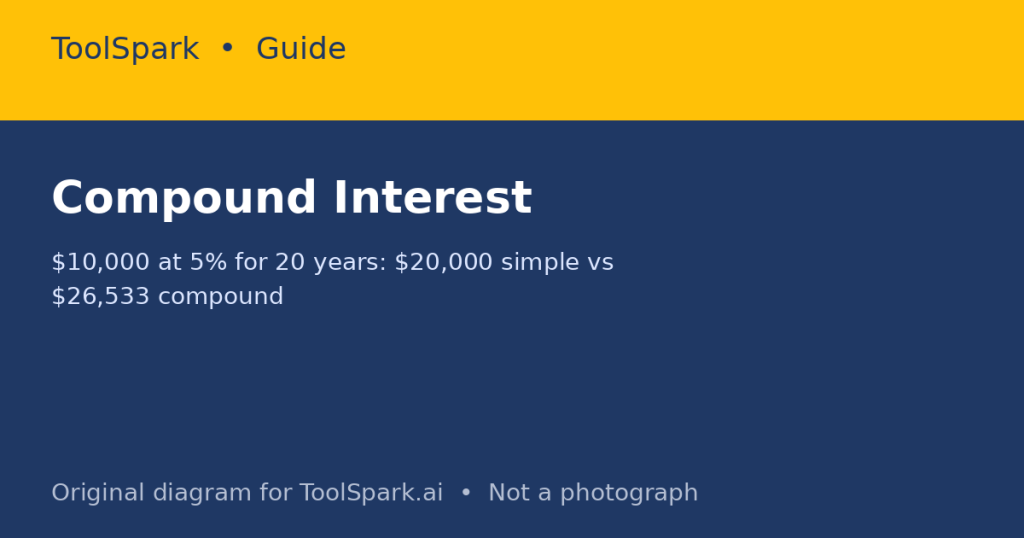
In short: Compound interest means interest is added to your balance, so interest is calculated on a larger balance. Use A = P(1 + r)^n, where P is principal, r is periodic rate, and n is number of periods. $10,000 at 5% a year for 20 years reaches $20,000 with simple interest, but $26,533 with compounding, with $6,533 interest on interest.
Table of Contents
Simple versus compound: one example, two very different endings
Take $10,000 at 5% a year for 20 years. With simple interest, you earn $500 a year, every year, for a total of $10,000 interest and a final $20,000. With annual compounding, the formula A = P(1 + r)^n gives $10,000 x (1.05)^20 = $26,533. The extra $6,533 is interest on interest. The gap grows with time and with rate, which is why a 20-year projection looks dramatically different from a 5-year projection even when the annual rate is the same.
With regular contributions, timing still wins
Suppose two people each contribute $200 a month at an assumed 6% annual return, compounded monthly. One starts at 25 and stops contributing at 35, then leaves the money invested until 65. The other starts at 35 and contributes until 65. The first person contributed for 10 years; the second for 30 years and three times as much money. In many standard illustrations, the earlier starter still ends ahead, because their money had 40 years to compound versus 30. The exact winner depends on the assumed return and on fees, and this article does not claim a universal result – run your own numbers in the ToolSpark Investment Calculator with your own contribution, rate, and time horizon, and change the rate to see how sensitive the result is. That sensitivity test is the most honest use of a calculator. You can also compare it with the Investment Return Calculator and the Retirement Calculator.
How to read a calculator result without being misled
1. Find the assumptions, not just the final number
A projection that assumes 10% a year, no fees, and no tax is a different statement from one that assumes 5% after fees and tax. The final number is meaningless without the assumptions that produced it. Write them down alongside the result.
2. Separate nominal return from real return
If your investment grows 6% in a year when prices rise 3%, your purchasing power grew by roughly 3%, not 6%. Inflation is not a fee, but it has a similar effect on what your money will buy. A retirement plan built on nominal returns alone will overstate what retirement will feel like.
3. Treat volatility as part of the return, not an exception to it
A calculator that compounds a smooth 7% every year hides the years when the market fell 20% and the years when it rose 25%. Real growth is bumpy. A smoothed projection is useful for planning, but it is not a forecast of any single year, and it should not be used to promise a retirement date.
4. Check fees as a negative compound rate
A 1% annual fee does not just take 1% of your final balance. It reduces the balance that compounds every year, so its effect also compounds. Over decades, a fee difference of 1% can change a final balance by a large amount. Always enter fees if the calculator allows it, or reduce your assumed return by the fee as a rough adjustment and say so in your notes.
The same maths, in reverse: debt
Article 4 shows the loan side of this formula. When you borrow, compound interest works against you: interest accrues on a balance that includes unpaid interest if you do not pay it. That is why minimum payments on a high-rate balance can feel like standing still, and why paying extra principal early has a disproportionate effect. The formula does not care whether you are saving or borrowing. The direction of the cash flow is what changes the outcome.
A practical way to use the ToolSpark calculators
- Enter a contribution you can actually sustain, not the maximum you hope to sustain.
- Run three scenarios: a cautious return, a middle return, and an optimistic return. Note how wide the range is.
- Subtract fees and, for a long horizon, adjust for inflation in your notes.
- Re-run the calculation once a year with your actual balance and contributions. A projection is a plan to revisit, not a number to frame.
This article explains a calculation. It is not personal financial advice, and it does not recommend any product, rate, or provider. For decisions involving retirement, tax, or a large sum, speak to a qualified financial adviser who knows your full situation.
Frequently Asked Questions
What is the compound interest formula?
A = P(1 + r)^n for a lump sum, where P is principal, r is the rate per period, and n is the number of periods. With regular contributions, each contribution compounds for a different length of time, so a calculator is more practical than hand calculation.
What is the difference between simple and compound interest?
Simple interest is charged or earned only on the original principal. Compound interest is earned on principal plus previously earned interest, so growth accelerates over time.
Does starting earlier really matter more than contributing more?
Often, yes, because earlier money compounds for more periods. The article shows a worked comparison, but the result depends on the assumed return, which is not guaranteed.
Is a calculator projection a promise?
No. It is a projection from assumptions you enter: return, contributions, fees, and time. Change any assumption and the result changes. Past returns do not guarantee future returns.
What is CAGR?
Compound annual growth rate: the smoothed annual rate that would take a starting value to an ending value over a period. It hides year-to-year volatility, so a high CAGR over a volatile period is not the same as a steady return.


Community Reviews & Discussion
Be the first in the community to share a tip, workflow suggestion, or review for this tool!