
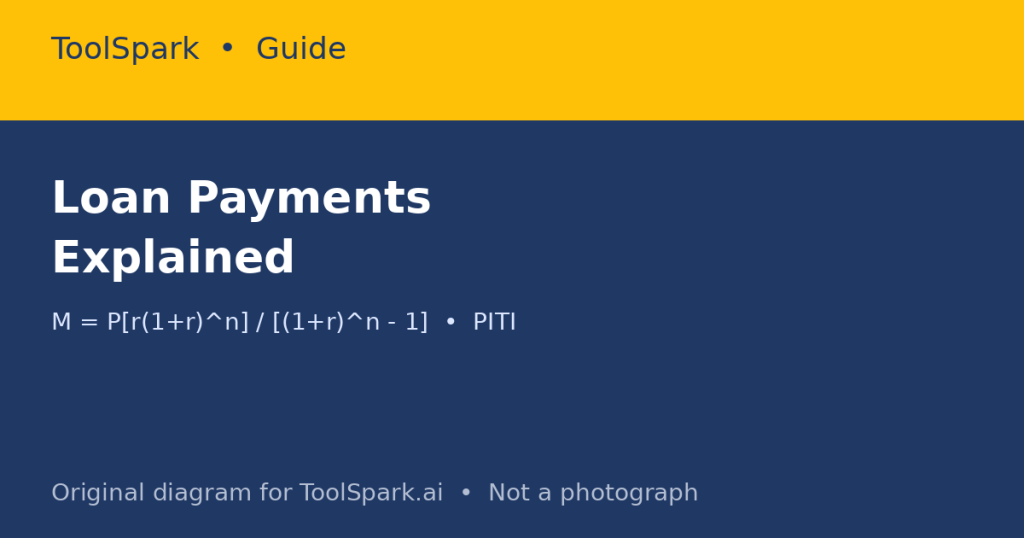
A loan payment calculation looks like a single number, but it is two numbers changing every month: interest on what you still owe, and principal that reduces what you still owe. The payment stays the same (for a fixed-rate loan) while the split inside it changes completely. Understanding that split is the difference between comparing loans by their monthly payment and comparing them by their total cost.
In short: A loan payment calculation uses M = P x [r(1+r)^n] / [(1+r)^n – 1], where P is principal, r is monthly rate, and n is number of payments. For a fixed-rate loan, the payment stays the same, but the interest-principal split changes monthly. $250,000 at 6.5% over 30 years gives about $1,580 in principal and interest only.
Table of Contents
Loan payment calculation: the formula, in plain language
M = P x [r(1+r)^n] / [(1+r)^n – 1]. P is the principal, the amount actually borrowed. r is the monthly interest rate, which is the annual rate divided by 12. n is the total number of monthly payments: a 30-year loan has 360, a 5-year loan has 60. The formula finds the fixed payment that, paid n times, repays the principal plus all the interest that accrues along the way. If the rate is 0%, the formula would divide by zero, so the payment is simply P divided by n – a useful edge case for 0% promotional finance, and a good test that a calculator handles it correctly.
Worked example: a $250,000 mortgage at 6.5% over 30 years
Here r = 0.065 / 12 = 0.0054167 and n = 360. Putting those into the formula gives a monthly principal-and-interest payment of about $1,580. That figure is principal and interest only. Over 360 payments, the total paid is about $568,800, so total interest is about $318,800 – more than the amount borrowed. That is not an error. It is what 30 years of interest on a large balance costs, and it is why term and rate matter as much as the monthly payment.
The amortisation schedule: why the split changes
| Stage | What happens to each payment | Balance |
|---|---|---|
| Month 1 | About $1,354 interest, about $226 principal | About $249,774 |
| Year 5 | Interest still dominates, but principal is rising | Balance falling faster than in year 1 |
| Year 15 | Roughly half interest, half principal (timing depends on rate) | Balance well below half only after the midpoint for a high-rate loan |
| Final year | Almost all principal | Balance reaches zero |
The exact month where principal overtakes interest depends on the rate: the higher the rate, the later that crossover happens. That is why two loans with the same monthly payment can have very different total interest if their rates or terms differ.
PITI: the payment you actually make each month
A mortgage payment in real life is usually PITI: principal, interest, property taxes, and homeowner’s insurance, plus private mortgage insurance (PMI) if the down payment is below 20% on a conventional loan. A calculator showing $1,580 for principal and interest is not wrong; it is incomplete as a housing budget. Add taxes and insurance from your actual quotes before you decide what you can afford, and ask your lender whether taxes and insurance are escrowed (collected monthly) or paid separately.
Three comparisons that matter more than the headline payment
1. Total interest, not just monthly payment
A longer term lowers the monthly payment and raises total interest, often dramatically. Compare the total interest column, not just the monthly figure, when you choose between a 20-year and a 30-year term.
2. Rate versus APR
Two offers with the same interest rate can have different APRs because of fees. APR is the better tool for comparing overall cost; the interest rate is the right input for the formula. Use both, for different jobs.
3. Extra payments, applied correctly
An extra $100 a month applied to principal does not just save $100 of interest. It reduces the balance that future interest is charged on, which can shorten the loan and reduce total interest. Confirm with your lender that extra payments are applied to principal, not held as advance payments, and check for prepayment penalties before you commit to a strategy.
How to check a quote with the ToolSpark calculators
Enter the amount borrowed (home price minus down payment for a mortgage), the annual interest rate, and the term. Read three numbers: monthly principal and interest, total interest, and total paid. Then add taxes, insurance and any PMI to get PITI. If a lender quote differs materially from the calculator, ask which inputs differ – rate, term, fees, or escrow – rather than assuming either figure is wrong. Calculators explain a calculation; they are not a loan offer, and they do not replace advice from a licensed lender or financial adviser for your specific situation. Try the Loan Calculator and the Mortgage Calculator.
Frequently Asked Questions
How is a monthly loan payment calculated?
With M = P x [r(1+r)^n] / [(1+r)^n – 1], where P is the amount borrowed, r is the monthly interest rate (annual rate divided by 12), and n is the total number of monthly payments.
Why is most of my early payment interest?
Because interest is charged on the outstanding balance, which is highest at the start. As the balance falls, the interest portion falls and more of each fixed payment goes to principal.
What is the difference between interest rate and APR?
The interest rate is what is charged on the balance each month. APR is a broader measure that includes certain fees and costs, so it is usually higher. Use the interest rate in the formula; use APR to compare the overall cost of different offers.
What does PITI mean?
Principal, Interest, Taxes and Insurance – the four parts of a typical monthly mortgage payment. A calculator that shows principal and interest only will understate your monthly housing cost.
Does paying extra actually help?
Yes, if the extra amount is applied to principal. It reduces the balance that future interest is charged on, which can shorten the loan and reduce total interest. Check whether your lender charges a prepayment penalty first.
Sources and further reading
- Amortization Schedule: Definition, Formula, and Calculation
- How to Calculate Loan Amortization: Formula and Schedule



Community Reviews & Discussion
Be the first in the community to share a tip, workflow suggestion, or review for this tool!