
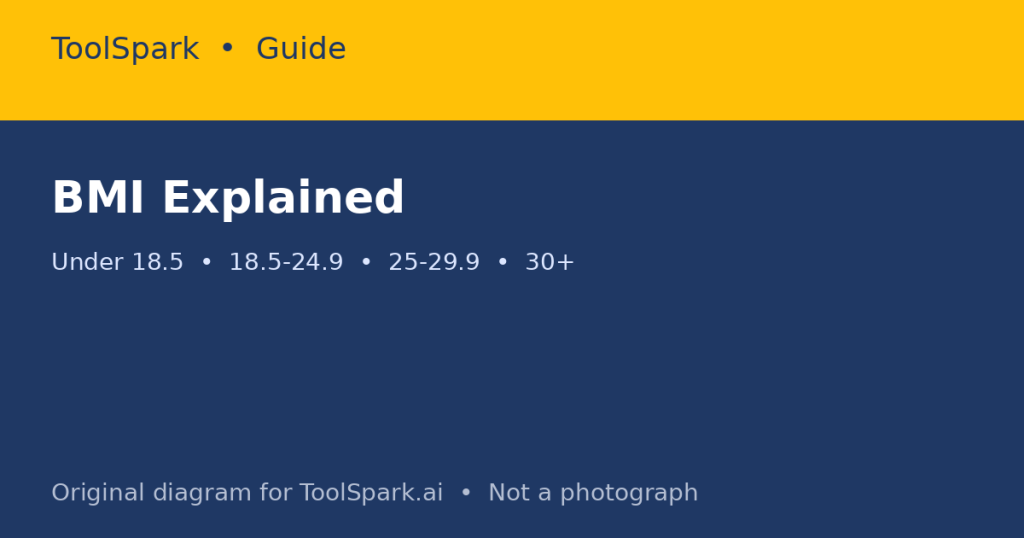
If you type your height and weight into a BMI calculator, you get a number and a category. That category feels like a verdict. It is not. It is a screening signal that was designed for populations, borrowed for individuals, and useful only when you also know what it leaves out.
In short: BMI is weight in kilograms divided by height in metres squared, a screening measure, not a verdict. For example, 70 kg and 1.75 m gives 22.9, in the healthy range of 18.5 to 24.9. BMI does not measure muscle, fat distribution, or fitness, so use it with waist circumference and, where relevant, body-fat estimates.
Table of Contents
How a BMI calculator works, and why it is so simple
BMI = weight (kg) / height (m) squared. Example: 70 kg and 1.75 m gives 70 / (1.75 x 1.75) = 22.9, in the healthy-weight range. The formula uses only two inputs, which is both its strength and its weakness: it can be calculated anywhere, from two numbers anyone can measure, and it ignores everything else that matters about a body.
What BMI does not measure
| Factor | Why it matters | What BMI does about it |
|---|---|---|
| Muscle mass | Muscle weighs more than fat per unit volume | Nothing – a muscular person and a sedentary person with the same height and weight get the same BMI |
| Fat distribution | Abdominal fat carries different health risks from fat elsewhere | Nothing – waist circumference is a separate measurement |
| Age and sex | Body composition changes with age and differs by sex | Only indirectly, through population averages |
| Bone density and frame | Two people can have different frames at the same height | Nothing |
| Fitness | Cardiorespiratory fitness predicts health independently of weight | Nothing |
That is why a clinician does not diagnose health from BMI alone. They combine it with waist circumference, blood pressure, blood tests, activity, diet, sleep, family history, and symptoms. A calculator that gives you only BMI is giving you one piece of a larger picture, and the article should say so plainly rather than letting the category do all the talking.
Body fat, lean mass, and ideal weight: three different questions
A body-fat calculator asks a different question from BMI: what proportion of your weight is fat? Methods range from skinfold equations to bioelectrical impedance scales to DEXA scans, and their accuracy varies widely. A home impedance scale can be off by several percentage points depending on hydration, food, and time of day, so its trend over weeks is more useful than any single reading.
Lean body mass is total weight minus fat mass. It is useful for some clinical and training calculations, including the Katch-McArdle BMR equation in Article 6, but it is still derived from an estimated body-fat percentage, so its precision is limited by that estimate.
Ideal weight formulas, such as Devine (originally for drug dosing) and Robinson, give a reference weight for a given height and sex. They were not designed as personal goals, and they do not account for muscle, frame, or health history. Treat an ‘ideal weight’ result as a reference range to discuss, not a target to chase at any cost.
When a result deserves a professional conversation
Seek professional advice rather than relying on a calculator if: your BMI is very low or very high; you have lost or gained weight unintentionally; you have diabetes, heart disease, thyroid disease, or another condition affected by weight; you are pregnant, breastfeeding, under 18, or over 65; or you have a history of disordered eating. In those cases, a calculator result is background information for a clinician, not a plan.
How to use these calculators well
- Measure height without shoes and weight on a consistent scale, in the morning if possible.
- Record BMI, waist circumference, and, if you use it, body-fat estimate together. One number in isolation is the least useful version of the story.
- Look at trends over months, not changes over days.
- Do not compare your body-fat estimate from one method with someone else’s estimate from another method. The methods are not interchangeable.
- If a result worries you, take the numbers to a clinician and ask what else they would want to know. That question is more useful than searching for a calculator that gives a ‘better’ category.
This article is general information, not medical advice. It does not diagnose, treat, or recommend a weight target for any individual.
Frequently Asked Questions
What is BMI?
Body Mass Index: weight in kilograms divided by height in metres squared. It is a screening measure that relates weight to height in a population, not a direct measure of body fat.
What are the standard BMI categories?
Underweight below 18.5, healthy weight 18.5 to 24.9, overweight 25 to 29.9, and obesity at 30 and above, in the widely used adult classification. These cut-offs are population guides, and some populations and clinicians use different thresholds.
Can you be muscular and have a high BMI?
Yes. Muscle is denser than fat, so a muscular person can have a high BMI with a low body-fat percentage. That is the best-known limitation of BMI.
What does a body fat calculator estimate?
It estimates body-fat percentage from measurements such as skinfolds, waist, neck, and height, or from validated equations. It is still an estimate, and different methods give different results for the same person.
What is ideal weight?
A range derived from height and sex using classic formulas such as Devine or Robinson. It is a statistical reference, not a personal target that everyone should aim for.


Community Reviews & Discussion
Be the first in the community to share a tip, workflow suggestion, or review for this tool!